How to Trick Multiple Choice Answer Sheet Scanners (And Why It Doesn't Work)
If you're planning to take standardized exams like the SAT, ACT, or GRE in North America, the ICFES (Saber 11) in Colombia, ENEM in Brazil, GCSE or A-Levels in the UK, Gaokao in China, JEE or NEET in India, ATAR in Australia, the Leaving Certificate in Ireland, Baccalauréat in France, Abitur in Germany, or any other paper-based multiple choice examination, you've probably heard rumors about "tricks" to beat the system.

The "Clever" Tricks Students Try
Over the years, students have come up with various creative (but misguided) strategies they believe will help them game OMR answer sheets when they don't know the correct answer:
-
🔵
Marking All the Bubbles:
The theory: "If I fill in all four options (A, B, C, D), the machine will count the correct one and ignore the others!"
-
⚫
Putting a Small Dot Inside:
The theory: "If I just put a tiny dot in the center instead of filling the whole bubble, maybe the machine won't detect it but a human grader will see I meant to mark it."
-
🔘
Marking Outside the Bubble:
The theory: "If I mark next to the bubble or partially fill it, the scanner will be confused and a human will have to review it."
-
✏️
Using Light Marks:
The theory: "If I barely shade the bubble, maybe the machine won't see it clearly and will give me the benefit of the doubt."
-
🎯
Erasing Incompletely:
The theory: "If I leave some eraser marks or smudges, the machine won't know which answer I really meant."
-
❌
Making X Marks or Check Marks:
The theory: "If I use an X or checkmark instead of filling the bubble, maybe it will confuse the system."
🚨 SPOILER ALERT: None of These Tricks Work! 🚨
In fact, these "clever" strategies are far more likely to hurt your score than help it. Let's dive into why OMR technology is smarter than these tricks, and what actually happens when you try them.
How OMR Technology Actually Works
Before we debunk each trick, you need to understand how OMR (Optical Mark Recognition) technology works. There are two main types used in standardized testing:
Hardware OMR Scanners (Traditional Method)
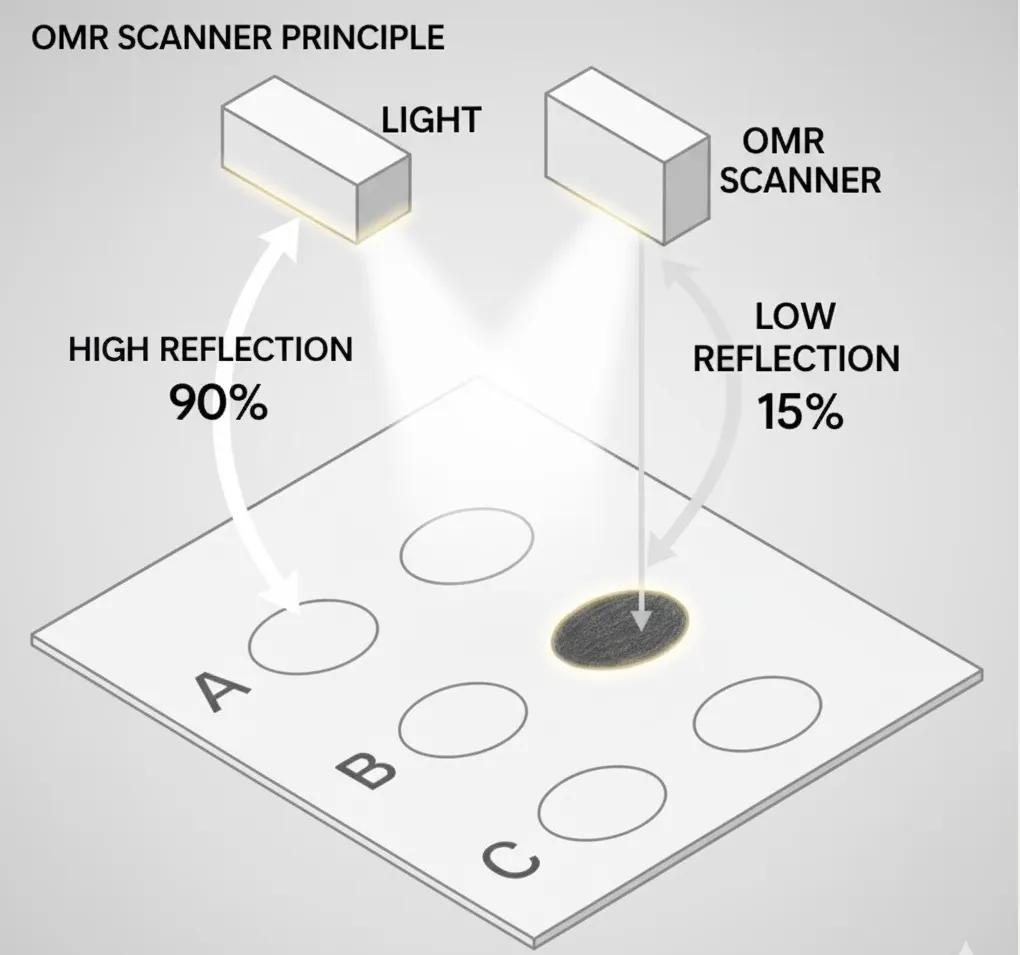
Most large-scale standardized tests (SAT, ACT, ICFES, ENEM, etc.) use dedicated hardware scanners like Scantron or DARA machines. Here's how they work:
- Light Beam Projection: The scanner projects focused light beams directly onto each bubble area on the answer sheet.
- Light Reflection Measurement: Optical sensors measure how much light is reflected back from each bubble position.
- Threshold Comparison: The machine compares the reflected light against a preset threshold. Unmarked bubbles (white paper) reflect lots of light. Marked bubbles (dark pencil or ink) reflect very little light.
- Binary Decision: If the reflected light is BELOW the threshold, the bubble is marked. If it's ABOVE the threshold, the bubble is unmarked. It's that simple - there's no gray area.
Software OMR (Modern Method)
Many schools, universities, and smaller organizations now use software-based OMR solutions like FormRead. These work differently but are just as unforgiving:
- Image Capture: The answer sheet is scanned or photographed, creating a digital image.
- Circle Detection: Computer vision algorithms identify the exact location of every bubble on the form.
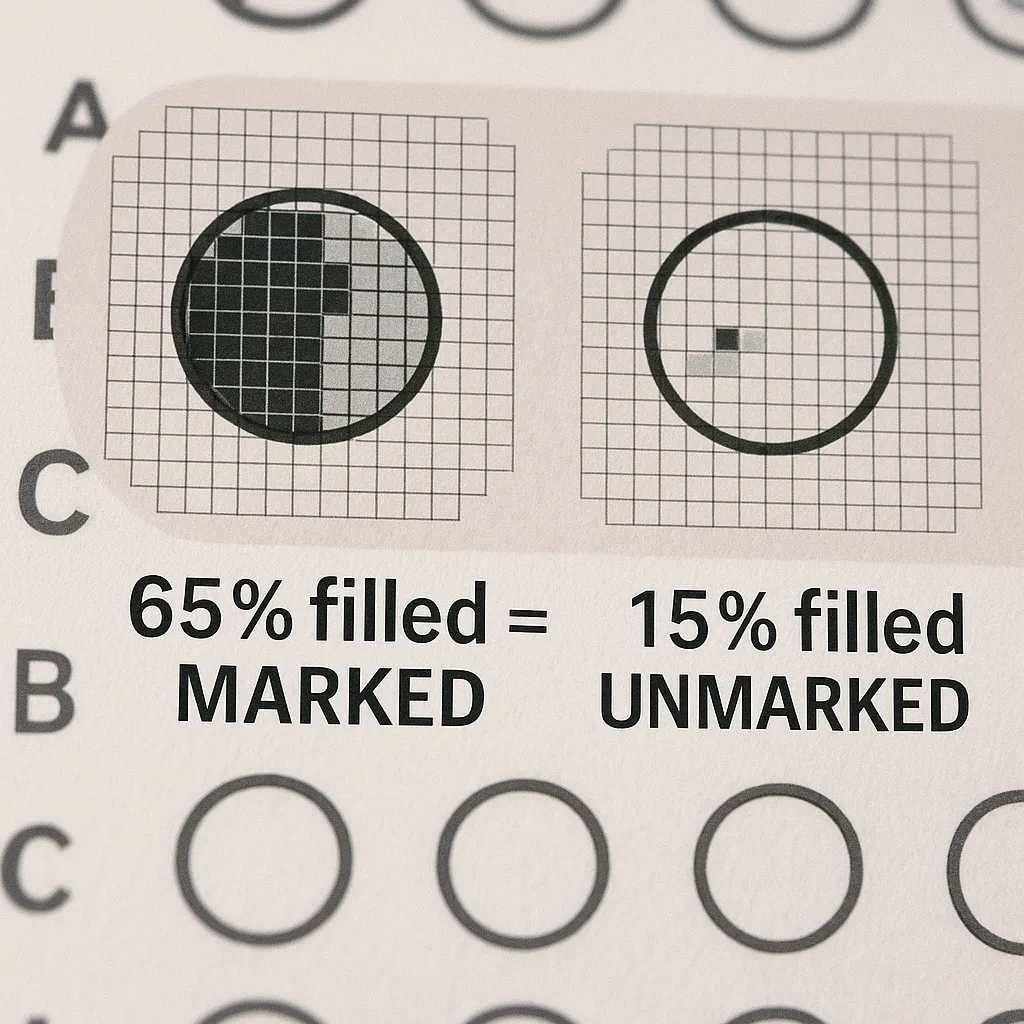
- Pixel Counting: The software counts the number of dark (black) pixels inside each detected bubble circle.
- Threshold Analysis: If the number of black pixels exceeds a threshold (typically 30-40% of the circle area), the bubble is considered marked. If not, it's unmarked.
- No Guesswork: The algorithm doesn't "guess" or "interpret" - it simply counts pixels and applies mathematical rules.
Why Each "Trick" Fails (And Makes Things Worse)
Now that you understand how OMR technology works, let's examine exactly why each of these tricks backfires:
❌ Trick #1: Marking All the Bubbles
What Students Think Will Happen:
"The machine will see all the marks and somehow pick out the correct answer, or at least give me partial credit."
What Actually Happens:
- Hardware scanners detect ALL the marked bubbles and flag the question as having multiple answers.
- Software OMR sees 4 circles each exceeding the pixel threshold and records "multiple answers detected."
- Result: The question is marked WRONG automatically. No partial credit. No human review.
- On most standardized tests, multiple marks = 0 points, same as leaving it blank or choosing wrong.
The Verdict:
You just guaranteed yourself a wrong answer. If you had randomly picked ONE bubble instead, you'd have a 25% chance of being right (for a 4-option question). This trick gives you 0% chance.
❌ Trick #2: Putting a Small Dot Inside the Bubble
What Students Think Will Happen:
"The dot is too small for the machine to detect, but if a human reviews it, they'll see I marked it."
What Actually Happens:
- The dot doesn't create enough dark area to cross the detection threshold (remember, 30-40% of the circle needs to be filled).
- Hardware scanners measure light reflection from the ENTIRE bubble area - a small dot barely affects the overall reflection.
- Software OMR counts pixels - a tiny dot represents maybe 5-10% of the circle, well below the 30-40% threshold.
- Result: The bubble registers as UNMARKED. You get zero points.
- No human reviews OMR sheets unless there's a formal dispute - and even then, they follow the machine reading.
The Verdict:
You're essentially leaving the question blank. Even if you knew the correct answer and tried this "strategy," you'd get it wrong.
❌ Trick #3: Marking Outside or Partially Filling the Bubble
What Students Think Will Happen:
"The scanner will get confused and trigger a manual review."
What Actually Happens:
- OMR systems only analyze what's INSIDE the bubble circle. Marks outside are completely ignored.
- Partial fills that don't cross the threshold are read as unmarked.
- Partial fills that DO cross the threshold are read as marked - which is fine if it's the right answer, but doesn't help if you marked multiple bubbles partially.
- There is no "confusion mode" that triggers human review. The machine makes a binary decision and moves on.
The Verdict:
Most likely outcome: unmarked = wrong. Best case scenario: you accidentally filled one enough to be detected, which is the same as just picking one answer normally (but with more risk of multiple marks).
❌ Trick #4: Using Very Light Marks
What Students Think Will Happen:
"The machine might not detect the light mark, giving me wiggle room."
What Actually Happens:
- Light marks don't reduce light reflection enough (hardware) or create enough dark pixels (software) to cross the detection threshold.
- Result: The bubble is read as unmarked.
- This is why exam instructions always say "use a #2 pencil and fill in bubbles completely and darkly."
The Verdict:
You get zero points for an unmarked answer. There is no "wiggle room" in OMR technology.
❌ Trick #5: Incomplete Erasing (Leaving Smudges)
What Students Think Will Happen:
"If I leave eraser marks in multiple bubbles, the machine won't know which one I really meant."
What Actually Happens:
- OMR systems detect ANY bubble where dark pixels/low reflection exceeds the threshold.
- Heavy smudges or incomplete erasures can still cross the threshold, causing the bubble to be read as marked.
- If multiple bubbles have smudges that cross the threshold: multiple marks detected = wrong answer.
- If smudges don't cross the threshold: those bubbles are unmarked, so you might end up with one answer (good) or no answer (bad).
The Verdict:
High risk strategy. You're essentially gambling that your smudges create exactly one detectable mark. More likely outcome: multiple marks = wrong, or no marks = wrong.
❌ Trick #6: Using X Marks or Check Marks
What Students Think Will Happen:
"Maybe the system will detect the X or checkmark as a valid answer."
What Actually Happens:
- OMR doesn't recognize shapes like Xs or checkmarks. It only measures darkness/pixel density.
- A small X or checkmark covers maybe 10-20% of the bubble - below the threshold.
- Result: Unmarked = wrong answer.
- Even if you make a large X that fills the bubble, it works the same as just filling it normally - so why take the risk?
The Verdict:
Either it doesn't register at all (unmarked = wrong), or you filled it enough that it works like a normal mark anyway. No advantage whatsoever.
The Real Math: Why Random Guessing Beats "Clever" Tricks
Let's break down the actual probabilities to show why these tricks are statistically terrible:
Scenario: 4-option multiple choice question, you have no idea of the answer
Strategy 1: Pick ONE bubble randomly
Probability of getting it right: 25% (1 in 4 chance)
Probability of getting it wrong: 75%
Expected value: +25% chance of 1 point = 0.25 points
Strategy 2: Mark all bubbles
Probability of getting it right: 0% (multiple marks = automatic wrong)
Probability of getting it wrong: 100%
Expected value: 0 points (guaranteed wrong)
Strategy 3: Put tiny dots in all bubbles
Probability of getting it right: 0% (dots don't register = blank answer)
Probability of getting it wrong: 100%
Expected value: 0 points (no marks detected)
Strategy 4: Leave it blank
Probability of getting it right: 0%
Probability of getting it wrong: 100%
Expected value: 0 points
The Winner: Random guessing (ONE clear answer) = 4x better than any "trick"
What You SHOULD Do Instead: Real Exam Strategies
✅ The Best Strategy (Obvious but True)
STUDY. Learn the material. Prepare properly. There is no substitute for actual knowledge.
Every hour you spend trying to find "tricks" is an hour you could have spent learning one more concept, practicing one more problem, or reviewing one more chapter. The ROI on studying is infinitely higher than the ROI on tricks (which is zero or negative).
✅ Strategy #1: Use Process of Elimination
Even if you don't know the right answer, you can often eliminate 1-2 obviously wrong answers.
- 4 options → random guess = 25% chance
- Eliminate 1 wrong → guess from 3 = 33% chance (+33% improvement!)
- Eliminate 2 wrong → guess from 2 = 50% chance (+100% improvement!)
✅ Strategy #2: Manage Your Time Wisely
Don't waste time on impossible questions. Mark your best guess and move on.
- Answer the easy questions first to bank guaranteed points
- Come back to hard questions if time permits
- In the last few minutes, make sure EVERY question has exactly ONE answer marked
✅ Strategy #3: If You're Running Out of Time - GUESS!
This is the most important tactical advice:
With 30 seconds left and 10 questions unanswered:
✅ DO: Quickly fill in ONE bubble for each (B-B-B-B-B or random pattern)
Expected result: ~2.5 correct out of 10 (25% hit rate) = 2.5 points
What NOT to do:
❌ DON'T: Leave them blank (0 points)
❌ DON'T: Mark all bubbles (0 points)
❌ DON'T: Try any "trick" (0 points or worse)
✅ Strategy #4: Mark Your Bubbles Correctly
Follow the instructions on the answer sheet:
- Use a #2 pencil (HB pencil) or the specified pen type
- Fill in bubbles COMPLETELY and DARKLY
- Mark only ONE bubble per question
- Erase completely if you change your answer (no smudges!)
- Don't make any stray marks on the answer sheet

Why Do These Myths Persist?
You might wonder: if these tricks don't work, why do students keep talking about them? Several reasons:
Misunderstanding of Technology
Most students don't understand how OMR actually works. They assume it's more sophisticated (and easier to fool) than it really is.
Urban Legends
"My cousin's friend's brother tried it and got away with it!" Anecdotes spread, but they're usually exaggerated or completely false.
Confirmation Bias
Someone marks all the bubbles and happens to pass. They credit the "trick" rather than the questions they actually knew or got lucky on.
False Sense of Control
When facing an exam you're unprepared for, believing in "tricks" feels better than accepting you should have studied more.
Lack of Transparency
Testing organizations don't usually explain their scanning technology in detail, so students fill the knowledge gap with speculation.
Final Verdict: The Only Real "Trick" is Hard Work
OMR technology - whether hardware-based light sensors or software-based pixel counting - is designed to be completely objective and immune to manipulation.
The machines don't have emotions, don't give partial credit, don't interpret intent, and don't get confused. They apply simple mathematical thresholds:
- • Darkness above threshold = marked
- • Darkness below threshold = unmarked
- • Multiple marks detected = wrong answer
- • No mark detected = wrong answer
That's it. There are no loopholes.
The Bottom Line
Before the exam: Study. Prepare. Learn the material.
During the exam: Answer what you know, eliminate wrong choices, manage your time.
Running out of time? Guess ONE answer for each remaining question. A 25% chance is infinitely better than 0%.
Don't waste energy on: Tricks, hacks, or attempting to outsmart the machine. They don't work, they reduce your score, and they waste time you could spend on actual questions.
Want to Learn More About OMR Technology?
If you're a teacher, school administrator, or organization looking to implement OMR for your own tests and surveys, modern software-based OMR solutions like FormRead make it easy and affordable - no expensive hardware needed.
You can create custom forms, scan them with any smartphone or scanner, and get instant results. Check out our other blog posts to learn more about how OMR works and how you can use it.
Conclusion
Whether you're taking the SAT, ACT, ICFES, ENEM, or any other standardized exam, remember this: The machines are smarter than the "tricks." The only reliable path to a good score is genuine preparation.
Don't fall for exam urban legends. Don't waste your time trying to game the system. Instead, invest that energy in learning, practicing, and preparing properly.
And if you absolutely run out of time? Pick ONE answer per question and move on. That simple strategy beats every "clever trick" ever invented.
Good luck on your exams! 📝
Study hard, mark clearly, and trust in your preparation.
Frequently Asked Questions
Does marking all bubbles on an OMR answer sheet work?
No. Hardware and software OMR both flag multiple marks on one question as "multiple answers detected" and score it wrong. A random single guess gives 25% odds on a 4-option question; marking them all gives 0%.
Will a tiny dot inside a bubble count as a mark?
No. OMR needs roughly 30-40% of the circle filled to register a mark. A dot is well under that threshold, so the bubble reads as unmarked and you get zero points.
Can partially filling or marking outside the bubble trigger a manual review?
No. Scanners only analyze what is inside each circle and make a binary filled/unfilled decision. Nothing about a partial mark triggers a human review - it just reads as unmarked.
Will a very light mark go undetected on purpose?
That's exactly what "undetected" means - it reads as unmarked. Light marks don't drop light-reflection or pixel-density enough to cross the detection threshold, so you lose the point instead of gaining wiggle room.
Do smudges from incomplete erasing confuse the scanner?
No - they just create extra risk. A smudge that crosses the detection threshold registers as a second marked bubble, turning a correct answer into a "multiple marks" wrong answer.
Can X marks or check marks fool an OMR scanner?
No. OMR measures darkness percentage inside the circle, not shape. A small X or check covers 10-20% of the bubble - below the threshold - so the bubble reads as unmarked.
What actually works on a multiple-choice exam?
Study, use elimination to improve guessing odds, manage time so no question is left blank, and fill bubbles completely with a #2 pencil. If time runs out, pick one answer per remaining question - 25% beats 0%.
Stop grading forms by hand.
Put FormRead to work now: create your form, scan your first sheet, and get structured results in minutes.
Start now — no credit card required